

Safety on Campus
Safety on campus is essential for ensuring that all members of the university can carry out their responsibilities in research, teaching, and academic studies to the best of their ability. Furthermore, the campus is a shared space where many people move about in different ways. Mutual consideration among pedestrians, cyclists, and drivers, as well as the issue of accessibility, are becoming increasingly important. Safety is not influenced alone by physical barriers or concrete hazards. Subjective feelings of insecurity or places that cause fear can also affect the quality of life on campus.
Have you noticed a dark area, a defect, or an obstacle on campus?

Often, the reason for poor lighting is simply a burned-out light bulb. In this case, you can report the burned-out bulb to the TU Dortmund Control Center at any time (Tel.: 0231 755-3333). Using the number on the light pole, the Control Center can then locate the defective light and have it repaired as quickly as possible.
Building managers are the first point of contact for all types of malfunctions or obstacles. The map showing the janitors’ areas of responsibility can help you find the right person to contact.
The Silent Cry for Help
With this silent call for help, people in danger can discreetly draw attention to themselves and ask for help. Various cases show that this hand signal can rescue people from their predicament. To ensure that those affected receive help, it is important to spread awareness of this hand signal.
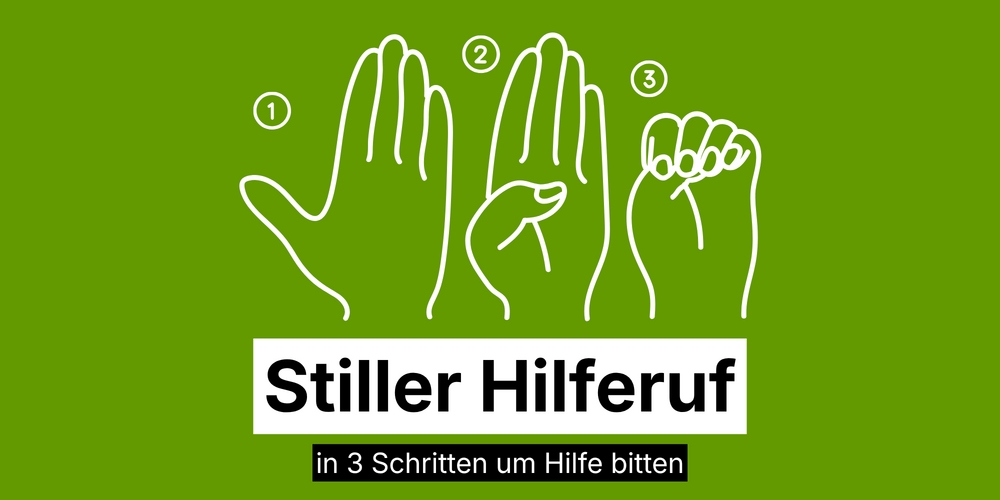
Here's how to signal for help silently:
1. Raise your hand.
2. Place your thumb inside your palm.
3. Enclose your thumb with your other fingers and make a fist.
Did you see the silent cry for help?
Discreetly signal to the person that you’ve noticed their call for help. Only speak to the person if they are alone. If the person is not alone, do not intervene in a confrontational manner—you could put yourself and others in danger. Stay calm, observe the situation, and, if necessary, seek assistance from others or, in an emergency, discreetly call the police.
Emergency Assistance
Site Inspection
In 2003, the Equal Opportunitys Officer began identifying poorly lit, hard-to-see, and dangerous areas on campus. Since then, she has organized a site inspection every two years, conducted in collaboration with staff from the Corporate Center Construction and Facility Management, the Office of Occupational Safety, Environmental and Health Protection, and the Division of Disability and Studies (DoBuS). In the run-up to these inspections, all employees and students at TU Dortmund University are encouraged to report locations they perceive as unsafe or threatening. Many of the areas subjectively perceived as dangerous have been made safer: For example, lighting in the parking lots on Emil-Figge-Straße was improved, bushes and trees were trimmed, lamps were cleaned, and light bulbs were replaced with higher-wattage ones.
The number of hazardous locations has been significantly reduced
Over the past few years, a lot has changed on campus and in the surrounding area. While 87 hazardous locations were listed in 2009, that number had dropped to just 23 by 2025. The number of locations falling under TU Dortmund University’s jurisdiction has decreased significantly in recent years. An improvement is particularly noticeable when it comes to lighting. However, new locations that employees and students perceive as dangerous continue to be identified from time to time.
Hazard Inspection 2027
You have until December 11 to report any hazardous areas or accessibility issues to us. These will then be reviewed during the inspection in January 2027, and a decision will be made on how to proceed.