

Learning Binary Code While Picnicking
- MinTU

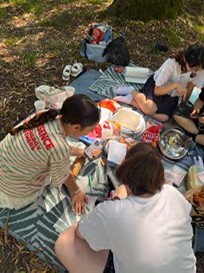
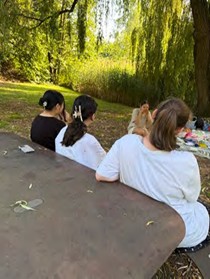
We met at 2:00 p.m. in front of the EF50. The meadow there, with its trees, is ideal for a picnic, and the weather was good as well. I had brought the blankets and the necessary supplies and set up the space. Each participant had also brought something to eat and drink. Before we got down to business, we set everything up together. Setting things up together made the arrival more relaxed and was already a first small group moment.
Afterwards, I kicked off an open discussion: How are you all doing? How’s school going right now? Which exams have you already taken, and which ones are still coming up? These questions quickly got the conversation going and gave me a sense of what’s on the girls’ minds right now and what’s important in their daily lives.

Getting to Know Each Other Through Profiles
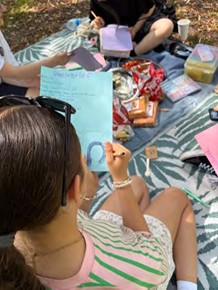
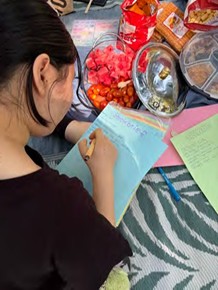
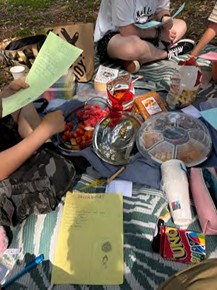
For the get-to-know-you phase, we played a profile game. Each mentee wrote her name on a piece of paper, and then the papers were distributed at random. The task was to ask the person holding each paper for information about themselves: date of birth, hobbies, favorite food, favorite color, favorite place, etc.
After each category, the sheets were passed around again. This way, by the end, every mentee had spoken with everyone else, rather than just having two fixed pairs. Finally, each person was asked to draw a portrait of the person whose name was on the sheet she had in her hand. This part generated the most laughter. At the same time, it was the moment when the group’s creativity really shone through.
From Source Code to Binary Code
The core activity of the day was a creative introduction to binary code. I formed two teams that were supposed to communicate with each other, but only using the digits 0 and 1.
They were free to choose how many characters to use. Nothing else was allowed. So the teams had to agree on their own set of rules beforehand. When one group got stuck, I gave them a hint—for example, 00001 for an A—and let them continue experimenting from there.
The evaluation was fascinating. We compared the different solutions and discussed together: What’s impractical about them? What can’t be expressed at all with this system? How could it be improved? Only after the mentees had identified these limitations themselves did I show them the ASCII code and ask which version was actually better: their own or the official one. The fact that the girls had discovered the weaknesses of their own system on their own made the comparison much more tangible for them than a mere explanation would have been.
We then agreed on a common code and used it to make bracelets, each with the girl’s first and last name. Green stood for 1, pink for 0, and we added blue for the spaces. Even though spaces aren’t actually necessary in binary code, this additional color made the result more readable and the structure more visible.


Movement and Word Games
After sitting and doing crafts for a while, it made sense to switch things up, so we started by playing some active games. This was followed by three guessing games, each played in newly mixed teams, so that the groupings kept changing:
Charades: One team member was given a word that had to be acted out, while their partner tried to guess it.
Drawing Game: The concept was similar, but the word had to be drawn instead of acted out.
Taboo: A term had to be explained without using certain specified words.
This sequence worked well because the tasks became more linguistic and abstract from game to game—progressing from physical gestures to drawings to verbal descriptions.


The End
At the end, we held a feedback session where each mentee could share what she liked and what she didn’t. Afterward, we cleaned up together, and at 7:00 p.m., the group went home.
All in all, it was a very successful day. By working together to solve puzzles, the students figured out the basic concept of binary code on their own. The day was full of variety, and hopefully they’ll remember it for a long time thanks to the discussions they had and the bracelets they designed themselves, which they were able to take home.