

Year-end at MinTU: A look back at physics, pizza and perspectives
- MinTU

The guests were welcomed by Vice-President Diversity, Prof. Petra Wiederkehr, computer scientist and Professor of Virtual Machining at TU Dortmund University. Petra Wiederkehr spoke about her own enthusiasm for STEM subjects, about the hurdles and opportunities that women face in this field of study and career, and about why more women are needed in STEM subjects - including at TU Dortmund University.
The evening was hosted by project coordinators Adina Korte and Tijen Atkaya. While Adina Korte explained the key points and the course of the project, Tijen Atkaya gave an insight into the scientific background: Studies show that girls are often rated lower than boys by their teachers in mathematics and science subjects, despite performing equally well - and also rate themselves more critically. This is precisely where MinTU comes in: Girls should be encouraged in a safe space to recognize their abilities and develop confidence in their strengths.

The importance of role models was demonstrated in the exchange with the mentors. They themselves study STEM subjects at TU Dortmund University and accompany the twelve to fourteen-year-old mentees through the program, show them the campus and take them on leisure activities away from the university. With the mentors, the mentees have contacts, guides and sometimes also fellow students. It was not only the mentees who occasionally encountered difficult content. One mentor said with a smile: "We've noticed that it's not just the mentees who sometimes don't understand the content - I often sit there and have to ask questions too."
Over the course of the year, the girls and their mentors visited eight STEM departments at TU Dortmund University on a total of four workshop days, giving them exciting insights into various subjects. Whether at DASA or during laboratory exercises at the university - the mentees were able to experiment, ask questions and gain their own experiences. One mentee summarized her insight as follows: "'I can't do that' just means: 'I can still learn that'."
For another mentee, the program was particularly important because it wasn't just about learning. It was also about making friends, getting to know university life and spending free time together: "Once we baked pizza in our mentor's shared flat - that was really cool." When asked what STEM relevance the pizza baking had, she replied with a laugh: "None. It was just delicious and fun."
In addition to fun and new friendships, concrete plans for the future also emerged. Engineering in particular aroused the interest of many girls and was mentioned as a possible study option after leaving school.


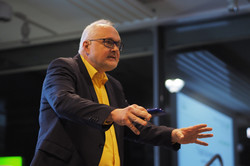
A highlight of the evening was the science show "Science is fun" by science editor Joachim Hecker. He used vivid experiments to demonstrate how ultrasound works. Using technical devices, he translated chewing chips and flowing water into ultrasound and showed how ultrasound makes it possible to look inside the human body. He then had girls and parents compete against each other to see who could hear the high-pitched ultrasonic sounds for the longest time. The result was clear: the parents had to admit defeat, as the ability to hear high frequencies decreases with age.
-
-

What does the audience know about bats? -

With technical assistance, the air bubbles in the water can be made audible to the human ear as ultrasound. -

Who can hear the ultrasonic sound the longest? -

Joachim Hecker uses an ultrasound device to display his eyeball on the screen. -

An ultrasound device can be used to look inside the human body.


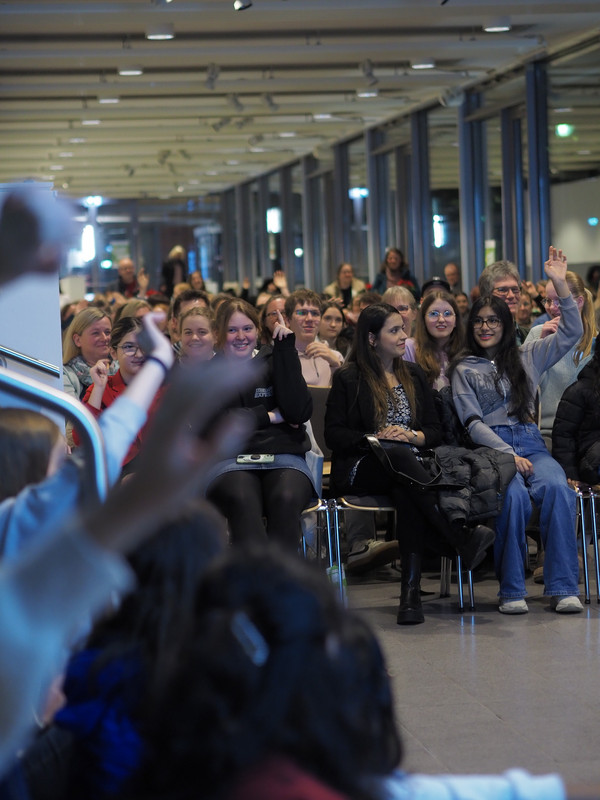


The science show was followed by the presentation of the certificates. The event then turned into a relaxed get-together: Over snacks and drinks, parents and participants got to talk to each other, exchanged impressions and reviewed the past months. For the mentees and mentors, the evening marked the end of an intensive year full of new experiences and friendships - others were already looking forward to the next round of MinTU - Mädchen in die TU Dortmund University.
Registration for the 2026 project round is still possible until 31.12.2025 via the registration form .
Related news
Successful last workshop day for the MinTU mentees between microorganisms and light frequencies

MinTU group proves its skills at black light minigolf

Exciting insights into logistics and statistics - from drones to diagrams
